Oracle Fusion Cloud Applications Suite (SAAS)
Oracle Fusion Cloud Enterprise Performance Management (EPM)
Oracle Cloud Enterprise Performance Management (EPM) Platform is a framework of the technical and functional components shared among Cloud EPM processes. It enables you to have a more unified user experience and simplified administration across different business functions.
Platform:
- Planning
- Profitability and Cost Management
- Financial Consolidation and Close
- Account Reconciliation
- Tax Reporting
- Narrative Reporting
- Freeform
- Enterprise Data Management

What is enterprise performance management?
Oracle Fusion Cloud Enterprise Performance Management (EPM)
Enterprise Performance Management (EPM) software helps you analyze, understand, and report on your business. EPM refers to the processes designed to help organizations plan, budget, forecast, and report on business performance as well as consolidate and finalize financial results (often referred to as “closing the books”). EPM solutions are primarily used by CFOs and the office of finance, while other functional areas, such as HR, sales, marketing, and IT, use EPM for operational planning, budgeting, and reporting.
EPM today—from on-premises to the cloud
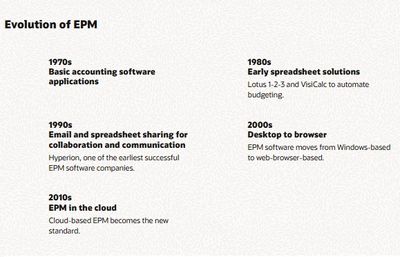
Over the past couple of decades, EPM software platforms evolved from Windows-based client/server systems to internet-enabled, web browser-based applications. Today, there’s an increasing demand for cloud-based EPM software, also known as software as a service (SaaS). When EPM software is “in the cloud” it simply means that the application is housed on a network of remote servers, instead of at a company’s location.
The cloud offers a more affordable alternative for EPM that lowers both operational expenses (OpEx) and capital expenses (CapEx), because it eliminates the need for companies to purchase software and hardware or hire additional IT staff. With no costly infrastructure to support, resources can be invested in growth opportunities, while employees can focus on more value-added tasks instead of managing IT.
Enterprise Resource Planning (ERP)
- Financials
- Project Management
- Enterprise Data Management
- Accounting Hub
-Risk Management and Compliance
- ERP Analytics
- Procurement Enterprise
-Performance Management
Supply Chain & Manufacturing (SCM)
- Supply Chain Planning
- Product Lifecycle Management
- Service Logistics
- Supply Chain Execution
- Procurement Logistics
- Order Management
- SCM Analytics